

Australian Horror
INTERVIEWS
ARTICLES
Finding Carnacki the Ghost Finder
OUR BOOKS
INFORMATION
REVIEWS
809 Jacob Street, by Marty Young
After The Bloodwood Staff, by Laura E. Goodin
The Art of Effective Dreaming, by Gillian Polack
Bad Blood, by Gary Kemble
Black City, by Christian Read
The Black Crusade, by Richard Harland
The Body Horror Book, by C. J. Fitzpatrick
Clowns at Midnight, by Terry Dowling
Dead City, by Christian D. Read
Dead Europe, by Christos Tsiolkas
Devouring Dark, by Alan Baxter
The Dreaming, by Queenie Chan
Fragments of a Broken Land: Valarl Undead, by Robert Hood
Full Moon Rising, by Keri Arthur
Gothic Hospital, by Gary Crew
The Grief Hole, by Kaaron Warren
Grimoire, by Kim Wilkins
Hollow House, by Greg Chapman
My Sister Rosa, by Justine Larbalestier
Path of Night, by Dirk Flinthart
The Last Days, by Andrew Masterson
Lotus Blue, by Cat Sparks
Love Cries, by Peter Blazey, etc (ed)
Netherkind, by Greg Chapman
Nil-Pray, by Christian Read
The Opposite of Life, by Narrelle M. Harris
The Road, by Catherine Jinks
Perfections, by Kirstyn McDermott
Sabriel, by Garth Nix
Salvage, by Jason Nahrung
The Scarlet Rider, by Lucy Sussex
Skin Deep, by Gary Kemble
Snake City, by Christian D. Read
The Tax Inspector, by Peter Carey
Tide of Stone, by Kaaron Warren
The Time of the Ghosts, by Gillian Polack
Vampire Cities, by D'Ettut
While I Live, by John Marsden
The Year of the Fruitcake, by Gillian Polack
2007 A Night of Horror Film Festival
OTHER HORROR PAGES

The Black Crusade
by Richard Harland. Chimaera Publications, 2004
Reviewed by Kyla Ward, 2004
"We are not nice people," Lord Sain began. "We're committed to evil in its ultimate form."
"Dear, oh dear," murmured Choldia. "Still, everyone ought to be committed to something in their lives."
 I should say up front that I am a great fan of the previous volume of this mise en scène, The Vicar of Morbing Vyle (Karl Evans Press, 1993), and count the author a friend. That out of the way, I can inform you that, at the end of Morbing Vyle, the protagonist Martin Smythe believed he had destroyed the quintessential evil of the titular character. He has since made discoveries which throw new light onto the origins, and possible fate, of his enemy, and introduces the tale to follow. The Black Crusade can be read without having already read Morbing Vyle, but doing so is likely to result in a frantic search for the previous volume once you have sampled its Vyleness.
The Black Crusade is set in 1894, a century before the events of Morbing Vyle but some decades after those of 'The Procyon Plate' (Agog! Fantastic Fiction, ed. Cat Sparks, 2002), which may or may not be related. The action commences in Buda-Pesth where Basil Smorta, an innocent young bank clerk, encounters a mysterious English nobleman and experiences love at first sight, a radical interpretation of Darwinian theory and unprecedented methods of overland transport, in rapid succession. This is followed by ritual ordeals and, well, a crusade, on which the fate of the world may hang.
The nobleman's full name is Lord Malicide Sain. If you have not previously read any Harland, this is one of the delights of doing so -- the elaborate and fitting names of his characters. Volusia, Felicity Driddle, the Reverend Squench; that's the kind of world we're in here. A world operating on principles that, while logical, are taken always to the most ghastly extremes. However, unlike Martin Smythe, who penetrated the insularity of Morbing Vyle, Basil Smorta journeys outwards through a series of increasingly peculiar locations during his reluctant participation in the Crusade. This journey is fraught. Not even the first person narration runs entirely smoothly. Mr Smythe has only been able to publish Basil's writings on the sufferance of a team of interfering editors, whose footnotes and excisions interact with the text in surprising ways.
There is a definite element of satire in The Black Crusade. It lies in the scientist Ingel Brankel and his vision for the future, and in the ideologically complex town of Orblast, among other encounters. But it also lies over and above the narrative, in the editors and their insistence that the book obey the formulae of popular fiction, discounting any thought that the story may in fact be true.
So, while not a simple book, this is certainly an intriguing one, containing more ideas in 217 digest-sized pages than many a doorstopper horror or fantasy (it easily counts as both). If it has a weakness, it lies in the climax. Of course, this is a near-universal problem with prequels (compounded by first-person narration). Harland provides appropriate resolutions and surprises, but it still did not satisfy me as did the ending of Morbing Vyle. But there is undoubtedly a symmetry to the fate of the Crusade, and as the editors have been noting, Basil is simply not equipped to be a classical hero. But would heroism, in the dashing in, sword drawn, cape flying sense, really be any help at all?
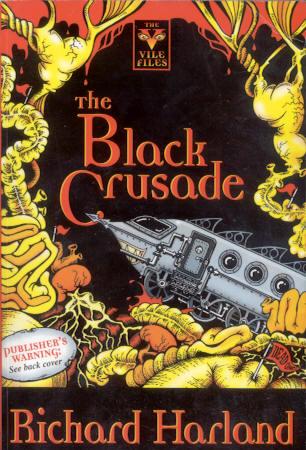
So, has the evil been finally exorcised? The answer may lie at vilewatch.com, which contains Martin Smythe's latest known communication along with reports from "vilewatchers" all over the world. By the way, the cover illustration reproduced here accurately represents sequences in the book. If that doesn't scare you, then by all means embark upon The Black Crusade.
- Richard Harland interview
- External link: Black Crusade homepage
©2020 Go to top
